
Home

Openness means more than simply informing the American people about how decisions are made. It means recognizing that government does not have all the answers, and that public officials need to draw on what citizens know. - President Obama


SLAPPs, or Strategic Lawsuits Against Public Participation, are meritless lawsuits brought on the basis of speech or petition activity. SLAPPs silence and punish those who engage in public participation, chilling speech that is essential to the functioning of our democracy and to the public interest.

SLAPPers across the political spectrum use the courts as a weapon against speech they don't like. SLAPPs can be absurd, such as when bar owners sued a magazine for $75,000 for calling their bar a "dive bar" - in a favorable review! SLAPPs can also be seriously chilling, with immediate consequences for democracy. In New Mexico,a nonprofit organization sent out educational fliers about members of the New Mexico state legislature. The fliers included voting records and some campaign contributions for each member. Several months later, three of the state legislators lost reelection. They sued the nonprofit organization over the educational fliers, alleging conspiracy and demanding that the election results be vacated.

Regardless of who is speaking and who is suing, everyone is losing when SLAPPs are allowed to continue. These meritless lawsuits clog the courts, waste resources and contribute to a general culture of litigousness. Instead of answering speech with speech, SLAPP filers answer speech with subpoenas and spurious claims.

SLAPPs frequently end in settlement, conditioned on silence, apology or retraction, so important ideas are excised from the debate, and critical information - about health, safety, economic security, civil rights and liberties, and government abuse - is withheld from the public. Would-be participants in public life see the devastating effects of lawsuits - on life savings, employment, reputation and even staying insured - and think twice before speaking out.

Judge Nicholas Colabella, Jr., famously said of SLAPPs that a greater threat to First Amendment rights can scarcely be imagined. SLAPPs chip away at the will and ability to speak out, person by person, group by group, issue by issue. James Madison cautioned that "there are more instances of the abridgment of the freedom of the people by gradual and silent encroachments of those in power than by violent and sudden usurpations," and his words ring true in the SLAPP context.

The Citizen Participation Act protects against SLAPPs by allowing the defendant of a meritless lawsuit arising from speech to have it quickly dismissed, and to recover the fees, costs and damages incurred in defending against it.

Legitimate lawsuits - true claims for relief - are not affected by the bill's procedural provisions. Only those lawsuits that use the litigation process as a means of harassment and intimidation are dismissed.

The law also sets forth standards for the unmasking of anonymous speakers' identity, and sharply limits discovery. Finally, the law provides civil immunity for petitioning speech - speech to the government to secure a government outcome. Petition speech, mentioned separately in the First Amendment, is the oldest and most fundamental of our speech rights, and the building block of a democracy.

Please join us in the fight to end SLAPPs.

Public Participation Project News

Public Participation Project Argues for Strong Interpretation of Illinois Anti-SLAPP Law

The Public Participation Project joined with the Citizen Media Law Project,Harvard Law School's Cyberlaw Clinic, the Online News Association and Chicago Current all worked to urge the Illinois appellate court to construe the Illinois statute in line with the clear meaning and intent of its language.

Illinois has one of the broadest anti-SLAPP laws in the country, but the trial court in this case appeared to believe that its language should be narrowly construed. Please see the CMLP website for the language of the briefs and more information about the case.

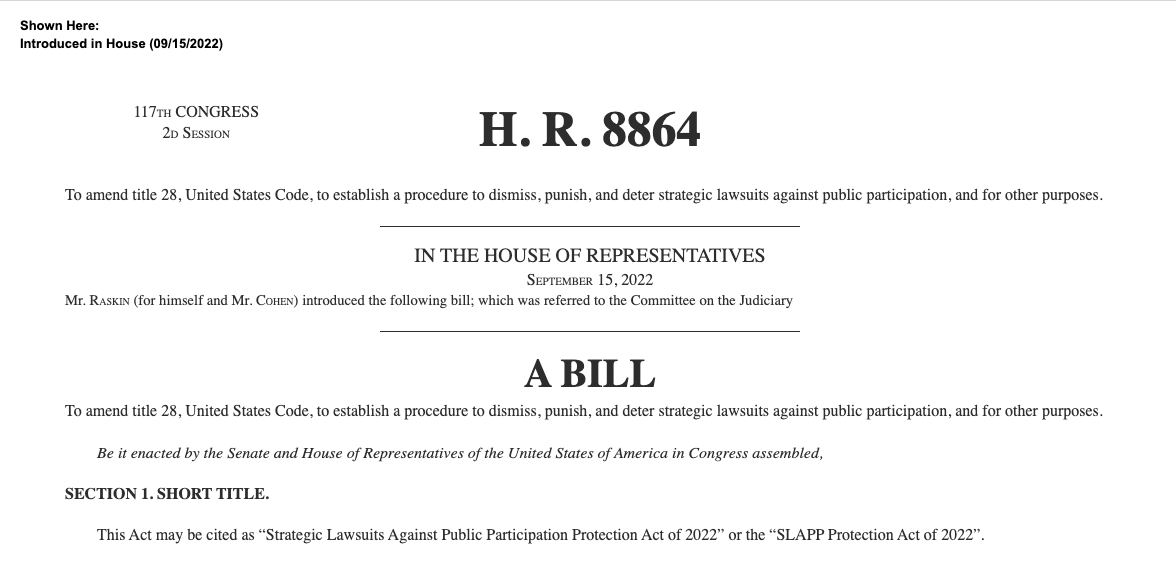
Rep. Steve Cohen (D-TN) introduces the Citizen Participation Act of 2009, H.R. 4364, in Congress.

Wednesday, December 15, Rep. Steve Cohen (D-TN), introduced an important piece of legislation to protect First Amendment rights. The Citizen Participation Act, H.R. 4364 would protect citizens who exercise the First Amendment rights of petition (communicating with their government) and free speech. Too often over the past few decades, those who speak out on important issues have become the targets of meritless lawsuits.

Examples of such lawsuits, frequently called SLAPPs (Strategic Lawsuits Against Public Participation), include:

- In Nebraska, farmers who reported a neighboring hog producer's farms violated environmental regulations were sued by the hog producer.

- In San Francisco, a police officer sued a woman who saw him beating a suspect and reported him for police brutality.

- In Minnesota, a man arrested on stalking charges sued the neighbor who reported the man's suspicious behavior to the police.

- In Texas, a person who had benefited from an eminent domain deal sued the author of a book about the deal, along with the book's publisher, a newspaper that reviewed the book, and Professor Richard Epstein, who had written a blurb on the book jacket.

These cases are only the tip of the iceberg in a disturbing trend to use the courtroom as a weapon to silence those who speak out on important issues. Rather than fight speech with speech, too many resort to meritless and even frivolous lawsuits to make the point that they are unhappy with another’s free expression or communication with the government.

The Citizen Participation Act would provide qualified immunity for petitioning activity, meaning that it protects good faith communications with the government – like reporting crimes, writing a letter to the school board, or testifying before Congress. These communications are the very foundation of a representative democracy, and petitioning activity is mentioned separately in the First Amendment. The CPA would protect those who are engaged in civic society, rather than allow them to be sued for their participation.

The law also provides procedural protections, for both petitioning activity and speech about an issue of public interest. A defendant who is sued for petitioning or speaking out on a public issue can make a special motion to dismiss. Once the defendant shows that the lawsuit arose from protected activity, the plaintiff has to show that her case has minimum merit, legally and factually. If the plaintiff cannot make this showing, the court must dismiss the lawsuit, and the defendant can recover fees and costs.

This burden-shifting scheme screens only meritless cases, and does so quickly. Further, while the motion is pending, neither party can take discovery, the expensive and time-consuming process whereby each party solicits information in the other’s possession. This way, costs are kept low, and so is the intimidation factor of the lawsuit. Too often, defendants cave into pressure of a lawsuit, because even a meritless lawsuit can take years and thousands of dollars to defend against. A defendant might “correct” or retract statements, or muzzle himself as part of a settlement agreement. The result is that private lawsuits can impose a gag on speech as effective as any government ban.

Rep. Steve Cohen is a staunch defender of First Amendment rights. Earlier this year, he sponsored legislation to end the practice of libel tourism, where those who speak out are sued in foreign courts (particularly those in Great Britain) that afford less protection for free speech.

More than eighty organizations and individuals have signed on in support of the Citizen Participation Act. To add your organization, please contact the Public Participation Project, which is spearheading the effort to secure passage of the Citizen Participation Act.

Syndicate content